
By Farrukh Zareef
Breaking the Agentic AI Paradox: Why Most Companies Stall and How to Break Through
Innovation isn’t optional – it’s survival. Disruption is the norm, and strong leaders steer through it by reshaping organizations and reinventing business models. History’s tech waves are clear: hesitation today becomes irrelevance tomorrow. We’ve seen countless companies fade because they wouldn’t adapt. Don’t be one of them.
AI can drive massive, positive disruption. The shift will take time but leaders shouldn’t wait. Move boldly now or risk falling behind. Moments like this decide which companies rise and which fade. The real risk isn’t thinking too big; it’s thinking too small.
The Gen-AI Paradox: High Adoption, Low Impact
So why the paradox? Most firms lean on horizontal tools for individual productivity. Those gains are real but diffuse. The bigger returns come from vertical applications that rewire core processes, yet these are harder to design, integrate, and scale. Breaking the paradox means shifting investment from generic tools to deep, domain-specific AI that moves the metrics that matter.
It’s time to close the experimentation chapter. A pivot only the CEO can make.
To operate effectively in the agentic era, organizations must build the foundations: upskill the workforce, adapt technology infrastructure, accelerate data productization, and deploy agent-specific governance mechanisms. That’s how directors and CEOs can turn scattered pilots into P&L outcomes, safely and at scale.
What Agentic AI Really Is (and Isn’t)
Agentic AI isn’t a chatbot. It perceives real-world context including documents and tickets; emails and chat threads; call-center transcripts and meeting notes; calendars, knowledge bases, and logs; IoT sensor data, images, and video; customer history, contracts/SLAs, pricing rules, and regulatory guidance. It then decides with policy controls and human-in-the-loop guardrails, and finally acts through your CRM, ERP, CMMS, EHR, or finance systems.
Implementing agentic AI isn’t a one-off project; it’s a new, permanent capability. The leaders who master it will shift from “humans assisted by tools” to “agents assisted by humans,” freeing people to focus on strategy, creativity, and the exceptions that truly require judgment.
A Practical CEO Playbook.
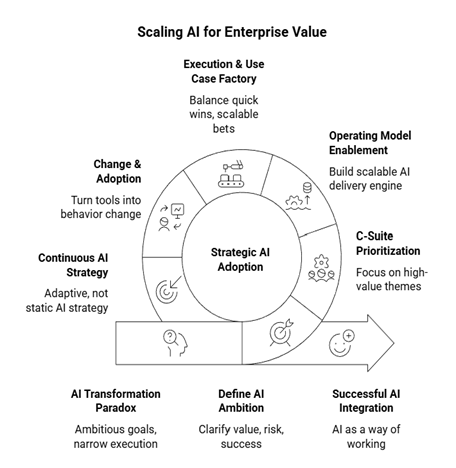
The Board must set the ambition for AI – whether to cut costs, reinvent business models, or disrupt the industry. The key
- Set AI ambition: optimize costs, transform models, or disrupt markets.
- Target value: specify where AI will deliver the most impact.
- Define risk: agree on what the company can responsibly tolerate.
- Measure and own: establish metrics and assign accountability.
The CEO and C-suite must translate Board ambition into focus: pick three to five enterprise-wide priorities – fewer, high-value themes with bold, measurable
Anchor the agenda on five strategic pillars:
- Customer Experience & Growth (AI-assisted sales and intelligent service);
- Operational Excellence (automation at scale and decision intelligence);
- Product & Innovation (AI-enhanced offerings and new business models);
- Workforce Augmentation (skills, copilots, and productivity);
- and Responsible AI & Trust (governance, ethics, and resilience).
This focus sharpens execution, accelerates impact, and makes progress unmistakable.
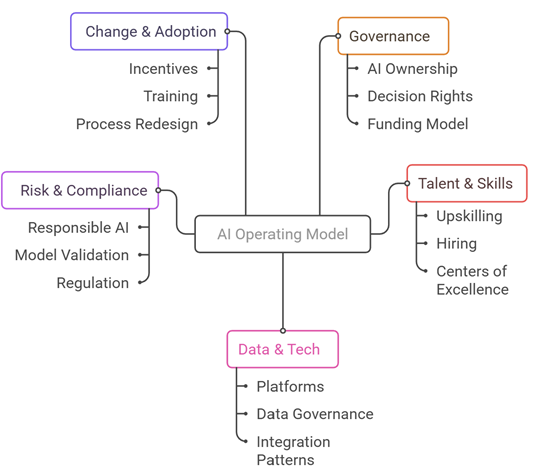
Next comes the operating model and execution – the pillars that turn your AI strategy into results. Start by establishing clear AI governance, building the right skills, and standing up a robust platform with strong data governance. Redesign key processes and use incentives and training to drive change and adoption. Finally, manage risk with rigorous compliance, model validation, and full alignment to regulations.
Winning in the era of AI isn’t just about speed – it’s about balance. Organizations that thrive don’t chase every breakthrough or stay stuck in short-term efficiency gains; they curate a portfolio of innovation that delivers today while building for tomorrow.
A well-calibrated horizon mix helps achieve this balance:
- 60% Horizon 1: Near-term value from automation, copilots, and productivity tools that deliver measurable ROI fast.
- 30% Horizon 2: Cross-business scaling initiatives such as enterprise-grade copilots that extend AI value across functions.
- 10% Horizon 3: Transformational, next-generation AI bets that redefine business models and unlock new revenue streams.
This mix ensures a steady stream of quick wins that fund and inform scalable innovation – while maintaining focus on the big, disruptive plays that will define the next wave of growth.
How to accelerate the execution by transforming pilot initiatives into enterprise-scale solutions.
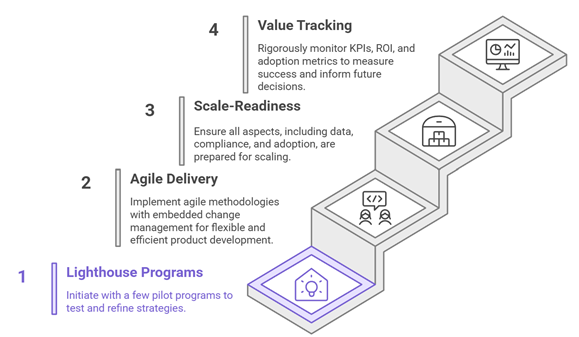
AI only creates value when people change how they work. Without adoption, the AI paradox persists: big technology spend, little business impact. The fix is intentional behavior design, pairing great tools with the rituals, incentives, and skills that make new ways of working stick.
What it Takes
- Target the “why” and the “how” for each role. Executives set outcomes and guardrails; managers translate use cases to team workflows; frontline employees learn task-level patterns and prompts.
- Provide step-by-step guides per function (sales, service, finance, ops): starter prompts, guardrails, before/after process maps, quality checks, and a 30-day habit plan.
- Build a common language (risk, prompts, retrieval, evaluation) and upskill motivated users to create and maintain low-code automations under governed standards.
- Measure and reward outcomes that reflect AI-enabled work: cycle time, first-pass quality, customer satisfaction, and throughput and not just hours spent.
- Publish clear guidance on data use, model limitations, and human-in-the-loop expectations.
AI strategy is not a one-time plan,it’s a living system. To stay ahead, organizations must treat AI as a continuous cycle of learning, value creation, and risk management. Static roadmaps quickly become obsolete; adaptive ones compound advantage.
- Quarterly Value & Risk Review with the Board
- Rebalance the Use Case Portfolio Assess each use case by impact vs. feasibility.
- Refresh Talent, Partnerships & Technology
- Raise the AI Maturity Floor Invest in the basics: data quality, literacy, governance, and change readiness.
What “Success” Looks Like
The AI Paradox Scorecard: Knowing You’re Creating Value, Not Just Activity
Many organizations invest heavily in AI but few translate that investment into real business outcomes. The difference lies in alignment, enablement, and culture. Use this scorecard to know you’ve avoided the AI paradox, where tools exist, but impact doesn’t.
Vision The Board and CEO speak with one voice on AI ambition, guardrails, and value creation.
Alignment 90% of AI investments ladder up to 3–5 enterprise themes—not a scatter of pilots. Every initiative has a business owner, success metrics, and a clear path to scale.
Enablement Teams have what they need to succeed: quality data, secure platforms, prompt libraries, and role-based training that make AI part of everyday work.
Execution AI outcomes show up in performance dashboards—tied directly to financial and customer KPIs like productivity, margin, and satisfaction.
Culture AI is not a project, it’s a way of working. Teams share wins, learn fast from misses, and continuously refine how they use AI to perform and grow.
When AI becomes part of the company’s rhythm, embedded in goals, tools, and behaviors, the company has moved beyond experimentation to enterprise value.

Professional in risk, finance, and management consulting with over 20 years of experience and extensive knowledge of the financial services industry, as well as a strong risk advisory background, with experience working in large organisations in Bahrain, Pakistan, the United Kingdom, and Saudi Arabia.