
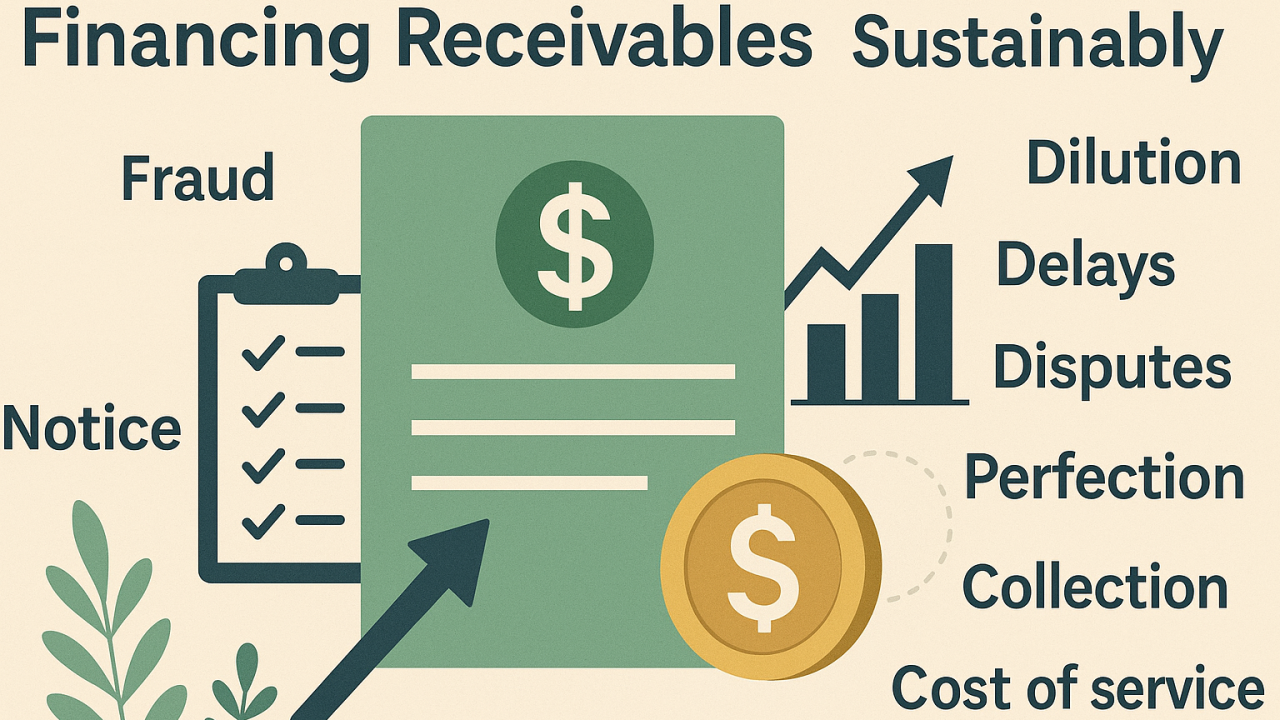
A core market need to close the SME financing gap
By Ali Ansari
At its most basic level, a receivable is money owed to a business. It appears on the balance sheet as an asset. In the real world of finance, however, a receivable is far more than a simple IOU.
Receivables are a core financial asset on SME and mid-market balance sheets. They underpin liquidity, shape working-capital cycles, and anchor access to short-term funding across most sectors of the real economy.
Yet despite their scale, receivables continue to be financed conservatively. Advance rates remain constrained, pricing often reflects uncertainty rather than observed performance, and access to funding varies widely even among companies with strong customers and stable operating cash flows.
Whether a receivable can be financed, sold, or digitally traded depends on a complex mix of commercial, legal, and operational factors.
While receivables finance is not “rocket science,” it is highly structured. There are three key areas that determine whether a receivable is truly valuable and transferable. If these are properly managed and automated, receivables can move from being static accounting entries to becoming digital, transferrable financial assets.
Key Risks That Define a Receivable’s Real Value
1. Credit Risk: Economic Value and Counterparty Behaviour
The starting point is straightforward: will the buyer pay, how much will they pay, and when will the cash actually arrive?
This goes well beyond the face value of an invoice. Credit risk is shaped by:
- The agreed amount, not merely the invoiced amount
- Expected dilution from credit notes, rebates, returns, or disputes
- The true period outstanding, based on historical payment behaviour rather than contractual terms
- The buyer’s credit profile, including how behaviour changes under stress
An invoice that has been issued but not approved carries materially different risk from one that is fully accepted in the buyer’s accounting system. Likewise, buyers who consistently pay 30 days late create structural pressure, even if they never formally default.
Financing structures fail not because buyers refuse to pay, but because cash arrives later and in smaller amounts than assumed. Accurate, real-time visibility into approvals, dilution, and payment patterns is therefore essential to any credible credit assessment.
2. Fraud Risk: Authenticity, Ownership, and Transferability
A receivable cannot be financed or transferred unless it genuinely exists and can only be financed once.
Fraud risk in receivables commonly arises from:
- The same receivable being pledged or sold multiple times
- Unclear or unenforceable assignment of payment rights
- Missing buyer notification or registration where required
This is fundamentally a trust and ownership problem, not a technology problem.
Legal perfection through assignment, notice, registration, and controlled collections is what converts a receivable from an unsecured exposure into a true financial asset. Without it, priority can be lost in insolvency regardless of good faith or documentation.
Automation plays a critical role here: funding should be impossible unless ownership is clean, exclusive, and enforceable.
3. Operational and Structural Risk: Execution and Loss Severity
Even where credit and fraud risks are well controlled, value can still leak through operational and contractual mechanisms.
Key risks include:
- Contractual deductions and performance penalties
- Set-off rights allowing buyers to withhold unrelated amounts
- Weak servicing, reconciliation, and dispute management
These risks determine not whether something goes wrong, but how much is lost when it does.
Structural mitigants such as credit insurance, guarantees, first-loss protection, and controlled accounts reduce loss severity but only if they are enforceable, monitored, and integrated into daily operations. Insurance does not eliminate risk; it reshapes timing and recovery. Guarantees are only as strong as the guarantor’s balance sheet.
Operational discipline is therefore inseparable from structural protection.
Why Structuring Receivable Deals Still Takes So Long
Even though these risks are well understood, structuring receivables transactions still takes months and sometimes years.
The primary reason is lack of visibility and dependency on humans for verification. Each party sees only part of the picture:
- Sellers control invoices and credit notes
- Buyers control approvals and payment timing
- Insurers control policy terms
- Financiers control legal ownership and funding
Much of this information is still exchanged manually via documents, spreadsheets, and emails. This creates delay, misunderstanding, and risk all in a market where invoices typically convert to cash within 30 to 120 days.
Embedded, Agentic Systems: A Structural Shift
The technology now is smart and swift enough to manage financing of receivables in a fully connected and automated manner. Fintechs can leverage agentic processes to connect deeply into:
- Seller accounting systems
- Buyer approval systems
- Payment networks
- Insurance platforms
- Legal ownership controls
and change the entire financing experience altogether.
Agent-driven systems can also automatically:
- Confirm invoice approval
- Monitor risk signals such as dilution and delays real time
- Adjust funding eligibility daily
- Enforce no-set-off and assignment rules
- Trigger legal ownership steps
- Monitor insurance limits and guarantor strength
- Recalculate risk as payment behaviour evolves
With technology enabling new ways of assessing and managing key risks within receivables in an automated and dynamic manner, the receivable can now become an attractive asset class that can unlock the most needed liquidity for businesses
Critical Reality Check: What Technology Cannot Eliminate
Even with advanced systems and automation, some risks cannot be engineered away.
Law still governs ownership. Courts not software decide who gets paid in insolvency. Digitization, automation, or tokenization alone do not override bankruptcy law.
Data quality remains the single largest risk. Automated systems are only as reliable as the data they receive. Poor or delayed data can be scaled just as easily as good data.
Insurance is not instant liquidity. Claims can be delayed, disputed, or denied. Guarantees depend on real balance sheets, not digital promises.
Final Thought
Receivables are among the oldest financial assets in the world. What is new is the ability to manage them as live, continuously governed digital instruments rather than static balance sheet entries reviewed periodically.

Ali is a seasoned fintech and banking professional who specializes in transforming businesses through innovative working capital, trade and supply chain finance strategies.
Over the past 25+ years, Ali has helped top tier banks and technology companies including, J.P. Morgan, HSBC and SAP develop and grow profitable businesses and serve thousands of their clients across the world. Ali has hands-on experience of solving problems for businesses operating in diverse industries, economic and geo-political landscapes in Asia, Middleast and Europe
Ali is passionate about solving problems and building sustainable businesses and relationships and helps businesses in driving business development, technology innovation, strategic partnerships & cusiness transformation.